


FROM THE STREET TO GEOGRAPHY: IRAN (Socıal Change and State Capacıty ın the Axıs of 2024–2026 Fıeld Fındıngs)
Dilruba Yıldız, August 2026
1. INTRODUCTION
The conflict process that erupted along the Israel/US-Iran axis as of February 28 deeply impacted the entire Middle Eastern geopolitics—primarily the Islamic Republic of Iran—and from time to time demonstrated a propensity for escalation through the involvement of regional actors. Unfolding under the shadow of intermittent diplomatic negotiations, mediation and peace initiatives by regional countries, and the contradictory decisions and rhetoric of US President Donald Trump, the war has now left its sixth month behind.
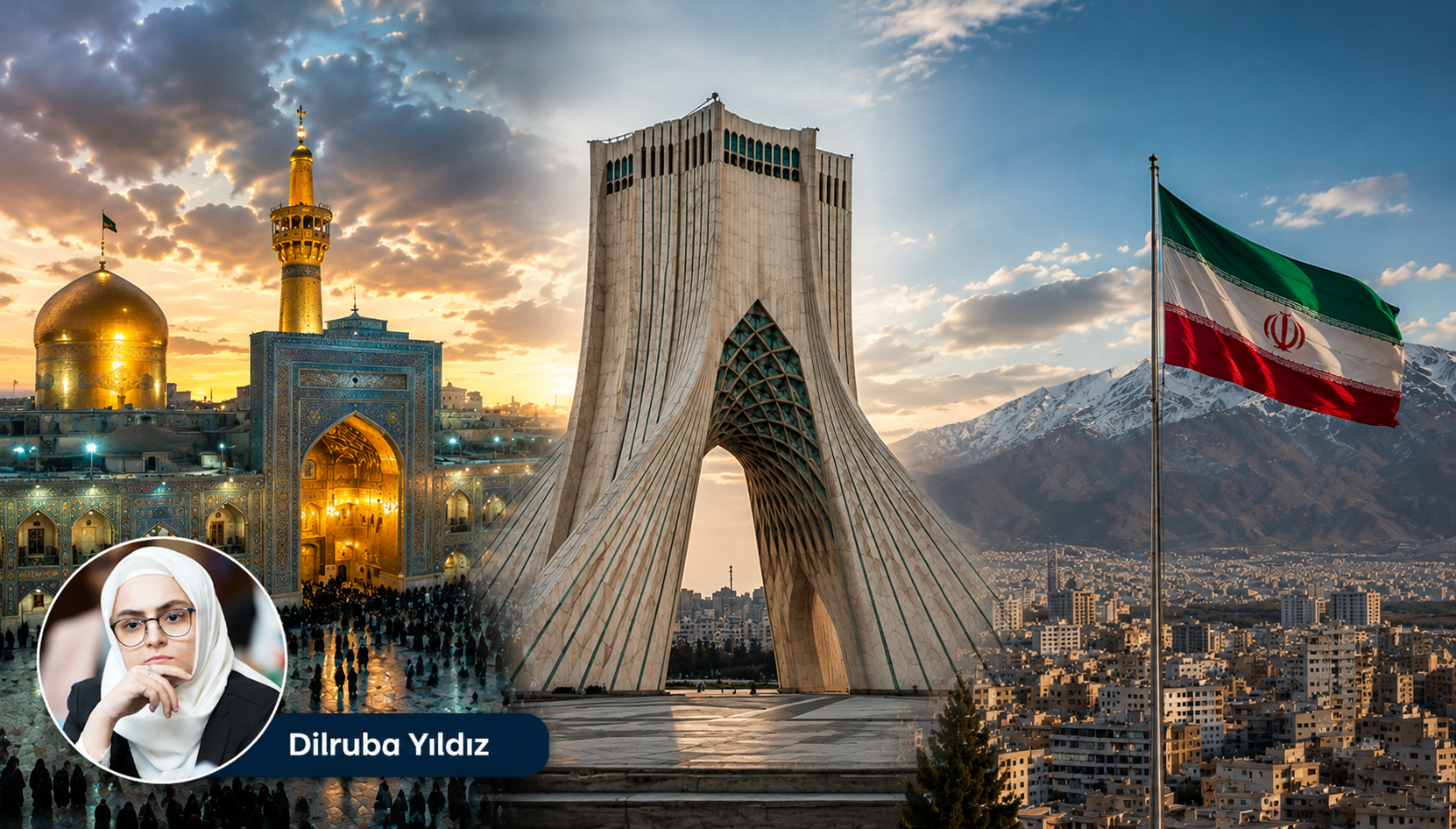
The empirical source of this study is grounded in the qualitative observations and field research of a researcher who directly experienced Iran on the ground across a three-year period spanning 2024, 2025, and 2026. This field report is based on 20 days of participant observation, semi-structured interviews, and symbolic analysis conducted throughout August 2026 across the Iranian cities of Mashhad, Kerman, and Tehran. Starting from the dynamics of the Arbaeen period, the study examines socio-religious mobilization, center-periphery relations, urban sociology, and the multi-axis transformation underway in Iran: Mashhad as the center of religious mobilization (Imam Reza Shrine), Kerman as the peripheral projection of political memory and state symbolism (Qassem Soleimani), and the capital Tehran as the urban-sociological manifestation of economic and political tensions.
2. SACRED SPACE AND SOCIO-RELIGIOUS MOBILIZATION: MASHHAD
2.1. Geopolitical Location, Security Climate, and Regional Transnational Pilgrimage Dynamics
Iran’s administrative structure is organized around the ostān (province) and shahrestān (county) system. As one of the 28 urban centers within Razavi Khorasan Province, Mashhad occupies a highly critical border geography, situated 70 km south of Turkmenistan and 150 km west of Afghanistan.
Within the scope of the field research, following arrival in Tehran on August 2, the Arbaeen period—one of the most decisive milestones on the Shia religious calendar—was observed in Mashhad two days later. Commemorating the 40th day after the martyrdom of Imam Hussein and his 72 companions at Karbala, Arbaeen generates mass mobilization throughout the months of Muharram and Safar across Imami pilgrimage centers such as Karbala, Najaf, and Mashhad. Hosting an annual average of 20 million visitors, the Imam Reza Shrine in Mashhad witnessed intense mass concentration despite the prevailing war climate and heightened security risks in the region.
This mass presence was constituted not only by Iranian citizens, but also by Arabs arriving from the Persian Gulf states and Shia groups of Afghan and Pakistani origin. As a researcher who previously spent time in Kuwait during the 12-Day War and closely observed Gulf sociology, it is noteworthy that Gulf societies—which typically lean toward risk avoidance and geographical relocation during crises—streamed into Iran in such heavy numbers under active wartime conditions. Furthermore, the fact that Gulf governments permitted these mass crossings, despite longstanding reservations regarding Iran’s regional influence policies and their restrictive postures toward domestic Shia minorities, demonstrates the cross-border strength of transnational religious mobilization.
From a military and security perspective, Mashhad was by no means isolated from the conflict environment. In Israel’s longest-range aerial strikes targeted against Iranian territory, military installations, ammunition depots, and the airport in Mashhad were directly targeted; footage of missiles traversing the airspace above the Imam Reza Shrine was broadcast widely. Consequently, mass religious mobility on the Mashhad ground occurred within an operational security climate characterized by direct targeting risks.
2.2. Civil Solidarity Networks, Mawkibs, and the Culture of Hospitality
The most fundamental sociological phenomenon observed in Mashhad throughout Arbaeen was the organizational capacity of civil society in Iran and the strength of traditional solidarity networks. During sacred periods such as martyrdom anniversaries and the months of Muharrem and Safar, the most salient component of the Shia public sphere is the civil hospitality tents known as “mawkib” (mokeb). Whereas in many Gulf countries public displays of Shia iconography (alam, mawkib, etc.) are barred from public spaces and restricted exclusively to mosque interiors, in geographies where Shiism is dominant at both state and societal levels, such as Iran and Iraq, mawkibs form the structural backbone of urban thoroughfares.
Refreshments provided at mawkibs range from a simple glass of tea to full course meals; cold water dispensers frequently display the inscription “al-Kafil.” Signifying the title of Abbas ibn Ali—the brother of Imam Hussein who was martyred after his arms were severed while attempting to bring water to the besieged camp at Karbala—al-Kafil serves as a visual memory emblem on water containers (while comparative observation with the Iraqi field reveals that this phrase constitutes a shared idiom across regional Shia iconography, it remains visibly more pervasive in Iraq).
Mawkib organization relies overwhelmingly on voluntary service and shift-based community labor. The sight of volunteers inside the shrine—including young children—repairing visitors’ shoes and sandals free of charge represents a concrete manifestation of this social dedication. State institutions supply infrastructural backing to this civic realm: for instance, under scorching temperatures reaching 40°C along the shrine avenues, civil mawkibs provide hospitality on one side while municipal fire trucks spray fine mist to cool pilgrims on the other, demonstrating state-society coordination. Nonetheless, financing and daily operations are driven primarily by wealthy benefactors and individual volunteers. The deep-seated hospitality code of Iranian culture reaches its apex during such religious pilgrimages, where independent actors distributing dates and biscuits individually within the shrine are routinely observed.
Moreover, it must be emphasized that compared to a nation that has endured war and remains in active conflict, Iranian society presents itself as remarkably consolidated, mutually attentive, and psychologically resilient.
2.3. Bodily Rituals (Azadari) and the Religious Discourse of the State
Field observations recorded the intense execution of traditional azadari (mourning) rituals, including sineh-zani (chest-beating) and maddahi (recitation of elegies and odes). While these rituals involve symbolic tapping of the head or rhythmic swinging of chains across the back and chest, these actions are performed without inflicting physical injury.
Marginal practices frequently circulated across internet and media channels, such as tatbir (bloodletting via swords or blades), were entirely absent in the field. Indeed, Supreme Leader Ayatollah Ali Khamenei banned bloodletting rituals during Arbaeen and Muharram commemorations, issuing a binding fatwa directing believers wishing to shed blood to donate blood to hospitals or organizations like the Red Crescent instead. Empirical findings confirm that such extreme bodily mortification practices are far more prevalent along the Pakistan, India, and partially Iraq corridors rather than inside Iran.
2.4. Demise of Charismatic Leadership and Sociology of Mourning: Ayatollah Ali Khamenei
One of the most profound and defining sociological findings from the Mashhad field was the dramatic transformation in public perception following the recent demise of Supreme Leader Ayatollah Ali Khamenei. Khamenei’s passing demonstrated that he attained the stature of a “national hero” across broad popular strata, extending even to secular segments that had historically maintained a critical distance from him and the regime. Statements from several interviewed secular individuals, such as “His true worth was understood only after he was gone” and “He was not appreciated while alive,” verify that perceptions of the leader’s persona transcended political polarizations in post-mortem collective mourning.
From a Shia theological vantage point, Khamenei’s death is interpreted as symbolically and directly congruent with the classic Husayni stance:
- Imam Hussein died fasting and thirsty at Karbala; Khamenei died while fasting on a day in Ramadan,
- Imam Hussein was slain alongside his family; Khamenei was killed together with members of his family,
- The martyrdom of Imam Hussein’s 6-month-old infant Ali Asghar parallels the killing of Khamenei’s 14-month-old granddaughter, Zahra Mohammadi Golpayegani, in the same strike,
- Imam Hussein refused surrender under any circumstance; Khamenei refused to retreat to an underground bunker during the attack, directly confronting Israeli strikes,
- Imam Hussein stood alone against Yazid, the tyrant of his era; Iran stands as the sole country directly fighting contemporary Israel,
- The historical overture to Hussein, “If you do not wish to die, you may negotiate with Yazid and pledge allegiance,” mirrors Khamenei’s refusal to enter compromise negotiations with the US-Israeli axis,
demonstrating how recurring symbols and motifs deeply embedded in Shia consciousness are mapped onto both figures and postures. This symbolic convergence elevated Ali Khamenei to an exalted spiritual standing in the eyes of the Iranian populace and the broader Shia community.
Khamenei’s burial took place in an area directly adjacent to the Imam Reza Shrine, rapidly transforming into a site of mass pilgrimage. In light of the leader’s political office and stature, the grave arrangement was constructed with notable simplicity and modesty. In stark contrast to Ayatollah Khomeini’s monumental mausoleum (haram) in Tehran, Khamenei’s resting place features neither a fortified architectural complex nor a traditional ornate zarih (shrine lattice). The grave consists solely of a wooden catafalque, a black cloth covering, and two framed photographs placed side by side depicting Khamenei and his granddaughter. While state media conducted uninterrupted live broadcasts from the gravesite, visiting crowds were observed breaking into tears without exception. This scene clearly reflects a collective sentiment that society lost not merely a political leader, but a “father of the nation,” underscoring the post-mortem symbolic reach of charismatic leadership. (Observations on the political and societal ramifications of Khamenei’s demise will continue in the subsequent Tehran section.)
3. POLITICAL SYMBOLISM AND CENTER-PERIPHERY RELATIONS: KERMAN
3.1. Geopolitical Position, Security Regime, and State Surveillance
Although Kerman is Iran’s largest province (ostān) by geographic area, its physical and administrative distance from the capital characterizes it with distinct provincial attributes, accompanied by a socially more conservative baseline. Within the internal field route mapped across the Tehran-Mashhad-Kerman-Tehran triangle, Kerman reinforces its peripheral isolation through extended travel durations (18 hours by train to Mashhad, 14 hours to Tehran). Though not an immediate border city like Mashhad, Kerman lies adjacent to a critical frontier zone. Located approximately 140 kilometers from the Pakistan and Afghanistan borders and bordering Sistan and Baluchestan Province, the city hosts a substantial Baluch population. Because the overwhelming majority of Baluchs are Sunni and armed Sunni-Baluch groups like Jaish al-Adl operate in the surrounding region, Kerman occupies a specialized standing from public security and surveillance standpoints.
Furthermore, the resting place of Qassem Soleimani—located in his native province of Kerman—was targeted in January 2024 during a memorial commemoration by ISIS-Khorasan (ISIS-K), resulting in a deadly dual bomb attack. These converging dynamics transformed Kerman into a high-security zone scrutinized by Tehran with intense intelligence vigilance. Throughout the war period, frequent raids were conducted against suspect residences, seizing covert arsenals and operational drones. Field accounts confirmed that baggage checks were routinely conducted on intra-city and intercity buses, accompanied by bureaucratic and security restrictions regarding the transport of computing hardware such as laptops.
This rigorous security regime was personally experienced during departure procedures for foreign nationals leaving the city. While online ticket acquisition from Mashhad to Kerman proceeded without hindrance, traveling by rail from Kerman back to Tehran necessitated physical in-person processing at Kerman Railway Station and mandatory passport verification by law enforcement officers (police control). Under active wartime and conflict conditions, the explicit purpose of visiting the city was subjected to direct interrogation; although the process was navigated successfully via established local contacts, it clearly illustrated the strictness with which the state operates its peripheral surveillance apparatus.
3.2. Spatial Symbolism, Memory Construction, and “Inqilabi” Provincial Sociology
The grave of Qassem Soleimani is situated within the Kerman Martyrs’ Cemetery (Golzar-e Shohada). Spatial semiotic analysis across the urban environment reveals that Soleimani’s memory is institutionally and socially commemorated at every level—from the central railway station to avenue, street, and transit stop names, as well as monumental murals and municipal billboards. While portraits of Supreme Leader Ayatollah Ali Khamenei were ubiquitous across all visited cities, visual depictions of Qassem Soleimani in Kerman quantitatively and qualitatively outnumbered Khamenei imagery by a substantial margin. The urban landscape curated around Soleimani has effectively evolved into a localized politico-religious memory hub.
A significant segment of Kerman’s population identifies politically and sociologically as “Inqilabi” (Revolutionary / pro-Revolution). Given the historical precedent that the 1979 Islamic Revolution gained vital momentum in provincial territories and succeeded through peripheral mobilization, this identity assertion assumes heightened significance in Kerman. The sociological reality that religiosity and social conservatism intensify as one moves away from the capital (Tehran) is mirrored directly in public dress codes. Compared to Tehran, the presence of women without headscarves in public spaces across Kerman is exceedingly rare.
Nonetheless, even in discussions conducted with secular-leaning individuals or those critical of state policies within this conservative urban fabric, a resilient admiration for Qassem Soleimani was evident. An assessment by one interviewee —”Everything began deteriorating after his death; things were not good before, but afterwards they became far worse”—reveals that Soleimani’s persona is decoupled from the current government apparatus. The reluctance of government critics to voice negative commentary regarding Soleimani underscores that the figure has transitioned into a national symbol of security and stability transcending the political regime itself. This situation demonstrates how Soleimani serves as a benchmark of legitimacy and national protection beyond formal state institutions. Interviewees’ reflections demarcate the boundaries of an enduring provincial respect anchored not in allegiance to the clerical political hierarchy, but in a yearning for national pride and sovereign stability.
The historical reality of the 1979 Revolution flowing from the provinces into the capital remains one of the foundational parameters governing contemporary center-periphery dynamics in Iran. The Kerman field provides a concrete case study of how loyalty to the state and revolutionary ideals interfaces with provincial conservative structures. Naturally, this does not imply the complete absence of local dissent; incidents of harassment directed by various individuals against citizens attending nightly pro-state solidarity gatherings and hospitality tents have been documented throughout the conflict.
4. CAPITAL SOCIOLOGY, POLITICAL SYMBOLISM, AND WAR CLIMATE: TEHRAN
4.1. Symbolic Iconography, Charismatic Leader Cult, and Succession Dynamics
Semiotic analysis of public spaces in Tehran demonstrates that nearly every key nexus of the capital is saturated with Ayatollah Ali Khamenei imagery. During earlier fieldwork in 2024 and 2025, portraits of Ayatollah Khomeini were frequently visible alongside Khamenei, with the latter slightly predominating as the active incumbent leader. In the August 2026 field, however—despite Mojtaba Khamenei having formally assumed the leadership office—imagery of Ayatollah Ali Khamenei overwhelmingly dominates the public arena, vastly outnumbering portraits of both Ayatollah Khomeini and Mojtaba Khamenei.
Particularly among conservative segments and chador-wearing women, Ali Khamenei has crystallized into a revered national icon. Carrying Khamenei’s picture on mobile phone wallpapers, protective cases, and in hand has become an ordinary facet of daily life. This iconographic emphasis is mirrored in municipal monument policies: a monumental sculpture was erected in Enqelab (Revolution) Square, the symbolic heart of Tehran. The monument depicts Khamenei’s left hand clenched in a defiant fist, prominently showcasing his distinctive ring. Engraved with the Quranic phrase from Surah Ash-Shu’ara (26:62), “Inna ma’iya Rabbi” (“Indeed, my Lord is with me”), the monument spatializes the official narrative of religious-political steadfastness embodied in the late leader’s persona.
4.2. Spatial Mobilization, Collective Memory, and War Iconography: Enqelab Square
As observed in Kerman and other provinces, citizens in the capital assemble nightly in public squares to demonstrate solidarity with the state. The central locus of this public mobilization is Enqelab Square. Having hosted millions throughout the 12-Day War and the February 28 crisis, the square continues to draw hundreds of participants on an uninterrupted nightly basis. On one side of the square, mawkib tents serve tea and water continuously; on the other, an open stage hosts elegists (maddahs) reciting mournful odes, clerics delivering sermons, and political analysts conducting public debates under the theme “Why Negotiations Must Be Rejected.”
The broadcast strategy curated across the square’s massive LED screens reflects the state’s methodology for preserving collective memory and manufacturing ideological legitimacy, tracing a structured chronological arc:
- Iran-Iraq War (1980–1988): Archival war footage invoking historical memory and the ethos of Holy Defense (Defa-e Moghaddas).
- Regional Allies and Axis of Resistance: ISIS attacks against regional partners; Ansarallah (Houthi) maritime operations against US naval vessels in the Red Sea.
- Current Conflict Dynamics: Battle imagery from the 12-Day War and the February 28 escalations, accompanied by biographical tributes and portraits of fallen military and political figures.
The culmination of the visual sequence with Ali Khamenei’s image consistently prompted the gathered crowd to recite collective prayers in emotional displays. Among carried banners, the slogan “We will not reconcile/negotiate with our leader’s killers” featured prominently. Notably, banners bearing the message “We seek revenge for our martyred leader” were prepared not only in Persian, but across multiple languages including English, Arabic, Spanish, Korean, Hebrew, and Chinese, illustrating a strategic targeting of international public opinion. Furthermore, posters styled as “WANTED” notices bearing the photographs of senior Israeli military-political figures—including Itamar Ben-Gvir, Eyal Zamir, Yossi Cohen, Roman Gofman, Avner Netanyahu, and David Zini—were posted throughout the perimeter.
Field observation additionally indicates that a significant cross-section of the population opposes diplomatic negotiations. Indeed, certain conservative factions openly express estrangement and intermittent anger toward Foreign Minister Araghchi and reformist-affiliated President Pezeshkian for engaging in diplomatic exchanges with the United States.
4.3. Urban Opposition and Diaspora Sociology: Diverging Discourses
Alongside state-directed mobilization, the Tehran field reveals distinct political perspectives among opposition segments regarding foreign policy and internal governance. Critical attitudes toward governance are readily discernible through Persian linguistic framing: dissidents consistently employ the term “The Regime” (Rejim) rather than the official term “The Government” (Hokumat).
An interview conducted with a Tehran taxi driver encapsulates how urban dissidents evaluate the US-Iran geopolitical equation. While describing US President Donald Trump’s rhetoric as erratic and lacking seriousness, the driver maintained that foreign military pressure is not aimed at the Iranian populace itself: “Trump’s issue is with the regime and the mullahs. If he wanted to destroy us, he could wipe us off the face of the earth.” This framing reflects a conscious effort among dissident citizens to draw a sharp distinction between the clerical leadership and the Iranian nation.
Conversely, an in-transit interview conducted during return travel with a female member of the Iranian-Canadian diaspora (a Toronto-based educator in her 60s) illustrated the discursive divide separating external diaspora groups from internal domestic realities. Despite widespread assumptions that the political diaspora forms a homogenous bloc favoring aggressive foreign intervention, secularism, and Pahlavi monarchism, the interviewee presented a more nuanced stance. With her headscarf resting loosely over her shoulders, she expressed profound grief over child casualties in Minab and deep anxiety for her family members residing in Iran.
When questioned about media portrayals claiming that the diaspora broadly endorses foreign military intervention, she surveyed her surroundings cautiously and lowered her voice: “It is something I cannot comprehend. Only certain Iranians in the diaspora support the US and the Shah’s son. Perhaps because they see no other alternative, but I cannot make sense of it. Trump is a thief; he goes from one country to another stealing their resources.” Constrained by the presence of fellow diaspora passengers on the flight, her guarded remarks demonstrate that diaspora sociology is fundamentally heterogeneous, and that opposition to domestic authoritarianism can readily coexist with vehement rejection of foreign military intervention.
5. GENERAL OBSERVATIONS: PUBLIC SPACE TRANSFORMATION, POLITICAL ECONOMY, AND GEOPOLITICS
5.1. Gender Practices, Public Space, and Normative Transformation
The transformation of public headscarf (hijab) practices in Iran provides longitudinal insight across the 2024–2026 period regarding the retreat of state enforcement mechanisms and the acceleration of societal secularization:
– During the April 2024 field (Tehran-Isfahan)—where aftershocks of the Mahsa Amini protests (October 2023) were still palpable—regular police units (Artesh/Faraja) and Moral Guidance Patrols (Gasht-e Ershad) maintained visible street deployments. In Tehran, the number of women observed without headscarves over a 5–6 day span was minimal (approximately 5 individuals), and non-compliance was practiced cautiously by keeping scarves around the neck for rapid adjustment. Similarly, female passengers on Istanbul-Tehran flights donning headscarves immediately prior to landing illustrated the continuing deterrence of state enforcement.
– By the October 2025 field, a noticeable rise was recorded in the number of individuals loosening or entirely removing headscarves; however, this trend was largely confined to youth cohorts aged 18–30. Chador visibility had noticeably receded.
– By August 2026, mandatory hijab enforcement had practically dissolved across Tehran’s public sphere. The shift has expanded across generational lines to encompass demographic groups aged 30–35 and above, with conventional jeans and t-shirt attire accompanied by the total omission of head coverings becoming standard.
Even in the religious hub of Mashhad and the traditionally conservative provincial setting of Kerman, women without headscarves or wearing minimal head coverings were regularly encountered. In Tehran, observing chador-wearing women during daytime hours has become rare, whereas their heavy participation in nocturnal state-organized rallies highlights a temporal and political bifurcation of the public sphere.
Field data confirm that despite official notices in public administrative buildings, railway stations, and museums warning that “Services will not be rendered to those violating hijab rules,” services are provided to unveiled citizens without interruption. Furthermore, the presence of LGBTQ+ individuals in prominent Tehran public parks without facing law enforcement intervention or overt public harassment underscores the broader deregulation of state normative policing.
The total absence of Gasht-e Ershad patrol vans and enforcement checkpoints over the past two years signifies that the state has functionally forfeited its capacity to regulate social behavior through dress mandates. Indeed, even secular and liberal interviewees noted that because the Amini protests were securitized by the state as foreign-manipulated threats involving separatist Kurdish elements, conventional street-level enforcement mechanisms became counterproductive and collapsed.
5.2. Fuel Regime, Subsidy Crises, and Political-Economic Risks
In August 2026, the most sensitive issue dominating domestic politics and political economy was the proposed fuel price hike and potential quota rationing. Media commentators, economic experts, and ordinary citizens frequently warned that a gasoline price increase carries the acute risk of triggering fresh civil unrest and mass uprisings.
Iran’s fuel distribution regime operates through a smart card system based on stratified volume tiers. Vehicle-owning households receive a monthly quota of 160 subsidized liters (roughly three full tanks for an average passenger vehicle), structured under the following pricing scale:
- First 60 Liters: 1,500 Tomans per liter (≈ 0.23 TL)
- Second 50 Liters: 3,000 Tomans per liter (≈ 0.71 TL)
- Third 50 Liters: 5,000 Tomans per liter (≈ 1.10 TL)
- Uncapped / Free Market Rate: 10,000 Tomans per liter (≈ 2.30 TL)
The primary intended objective of this electronic quota system is curtailing extensive fuel smuggling into neighboring states (notably Afghanistan and Pakistan). In economically disadvantaged border regions such as Sistan and Baluchestan, cross-border fuel smuggling (sookht-bari / تخوسب?تخوسیرب) has entrenched itself as an indispensable livelihood mechanism for local populations.
Nonetheless, the fuel crisis is driven by profound structural and geopolitical bottlenecks:
- Supply-Demand Deficit: Official 2026 data indicate that while domestic gasoline production stands at 105 million liters per day, daily consumption has surged to 135 million liters, generating an acute daily deficit of 30 million liters.
- Refining Constraints: Despite possessing vast crude petroleum reserves, international sanctions and technological impediments severely constrain domestic refining capacity and output quality.
- Fiscal Burden: Decades of heavy universal fuel subsidies impose an unsustainable financial drain on the national state budget.
Widespread reports that the government plans to increase the non-subsidized fuel rate from 10,000 Tomans to 87,000 Tomans per liter (an 8.7-fold increase) threaten an inflationary shock across transport and logistics, directly driving up basic commodity, food, and textile prices. This macroeconomic pressure significantly elevates the risk of economically vulnerable classes returning to the streets.
5.3. Infrastructure Crises: Ecological Risks, Water, and Electricity Outages
During the summer months, both the arid southern provinces and the capital Tehran suffer severe water and electricity deficits. Even during the winter of 2025, water disruptions in university dormitories ignited student demonstrations that compelled authorities to reverse scheduled cutoffs, illustrating how infrastructural vulnerabilities catalyze social unrest. In that same period, administrative discussions even surfaced regarding the potential relocation of the capital away from Tehran due to water table depletion. While increased precipitation during the war period offered transient relief, desertification and chronic drought remain structural security challenges for Iran.
Electrical grid deficits are felt with greater severity across the provinces. In Kerman, domestic water supply is not maintained through baseline municipal line pressure, but depends upon residential storage cisterns and electric booster pumps (hydrophores). The city experiences scheduled, rotating two-hour power outages across neighborhoods on a weekly basis.
As exemplified in Kerman, the reliance of municipal water delivery on electric booster pumps creates a severe risk of “cascading infrastructure collapse.” The moment electrical power fails, booster pumps shut down, rendering water tanks inaccessible and triggering an immediate simultaneous water crisis. Field observations reveal that the centralgovernment deliberately shields Tehran from these outages to avert civil unrest in the capital, shifting the infrastructural deficit onto provincial urban centers.
5.4. Geography, Topography, and Geopolitical Assessment
Extensive overland travel across the Tehran-Mashhad, Mashhad-Kerman, and Kerman-Tehran corridors provided direct qualitative validation and refinement of the established “Iranian geographic fortress” thesis prominent in security studies and international relations.
While standard strategic analyses predominantly emphasize the peripheral Zagros and Alborz mountain ranges encircling Iran’s outer perimeter, the internal topography reveals a relentless, repeating sequence of “mountain–desert–mountain–desert” terrain (including the Tabas Desert along the Mashhad-Kerman route, site of the failed US Operation Eagle Claw in 1980).
In the event of a foreign conventional land invasion, penetrating into the interior remains exceedingly difficult even if peripheral border mountains were breached. Iranian topography mandates traversing barren, steep rocky mountain ridges devoid of vegetative cover, interspersed with arid desert basins, between virtually every major urban center.
This geomorphology creates immense supply-line vulnerabilities, astronomical logistical requirements, and severe flank insecurity for any conventional ground force. Consequently, Iran’s physical topography operates as the foundational geopolitical actor that naturally reinforces the state’s asymmetric doctrine of defense-in-depth, rendering the country an inherent natural fortress against foreign occupation.
(To download the article in PDF format, click here)
.
Dilruba YILDIZ
SASAM Iran Expert

- FROM THE STREET TO GEOGRAPHY: IRAN (Socıal Change and State Capacıty ın the Axıs of 2024–2026 Fıeld Fındıngs) - 27 Ağustos 2026
- SOKAKTAN COĞRAFYAYA İRAN: 2024–2026 SAHA BULGULARI EKSENİNDE TOPLUMSAL DEĞİŞİM VE DEVLET KAPASİTESİ - 27 Ağustos 2026
- TÜRKİYE’NİN SOMALİ UZAY LİMANI PROJESİ - 25 Ağustos 2026
- SASAM ERASMUS PROJESİ KAPSAMINDA DÜZENLENEN HOLLANDA PROGRAMI DEĞERLENDİRMESİ - 24 Ağustos 2026
- ERASMUS+ PROJEMİZ KAPSAMINDA HOLLANDA’YA KURS VE ÖĞRENİCİ GRUP HAREKETLİLİĞİ GERÇEKLEŞTİRİLDİ - 24 Ağustos 2026
- ERASMUS+ PROJEMİZ KAPSAMINDA POLONYA’YA İŞBAŞI GÖZLEM HAREKETLİLİĞİ GERÇEKLEŞTİRİLDİ - 17 Ağustos 2026
- BEŞ SORUDA EŞ-ŞEBAB: ÖRGÜTÜN AMAÇLARI, BÖLGESEL FAALİYETLERİ VE TÜRKİYE BOYUTU - 16 Ağustos 2026
- KIBRIS DENKLEMİNİN DİĞER YÜZÜ: FİDAN’IN UYARILARI VE GÜNEY KIBRIS’IN İSRAİL TERCİHİ - 16 Ağustos 2026
- RUS MEDYASINDA MEKKE PAKTI - 8 Ağustos 2026
- MEKKE SAVUNMA ANLAŞMASININ SUUDİ BASININDA YANKISI - 8 Ağustos 2026
-

SOKAKTAN COĞRAFYAYA İRAN: 2024–2026 SAHA BULGULARI EKSENİNDE TOPLUMSAL DEĞİŞİM VE DEVLET KAPASİTESİ
Dilruba Yıldız Yazıları, İran, ÜLKE MASALARI -

HÜRMÜZ BOĞAZI VE STRATEJİK ÖNEMİ
İran, ULUSLARARASI İLİŞKİLER, Umman -

SÖYLEŞİYE DAVET: “2. TRUMP DÖNEMİNDE ABD VE DÜNYA”
Amerika Birleşik Devletleri, DUYURULAR, ULUSLARARASI İLİŞKİLER